Blog
Guides for prop firm traders
Prop-firm compliance, multi-account execution, trading psychology, and product deep-dives.

Pass a Prop Firm Challenge: The Indian Trader's Guide
Only 5–10% of traders pass a prop firm challenge on their first attempt — and it's rarely a strategy problem. How to choose the right firm, size positions correctly, and avoid the failure patterns that end most evaluations.

Prop Firm Challenge Rules: What Every Trader Must Know
The industry pass rate sits at 5–10%, mostly because traders misunderstand a specific calculation, not because they can't trade. How drawdown, phase, news, and hedging rules actually work — and where breaches really happen.
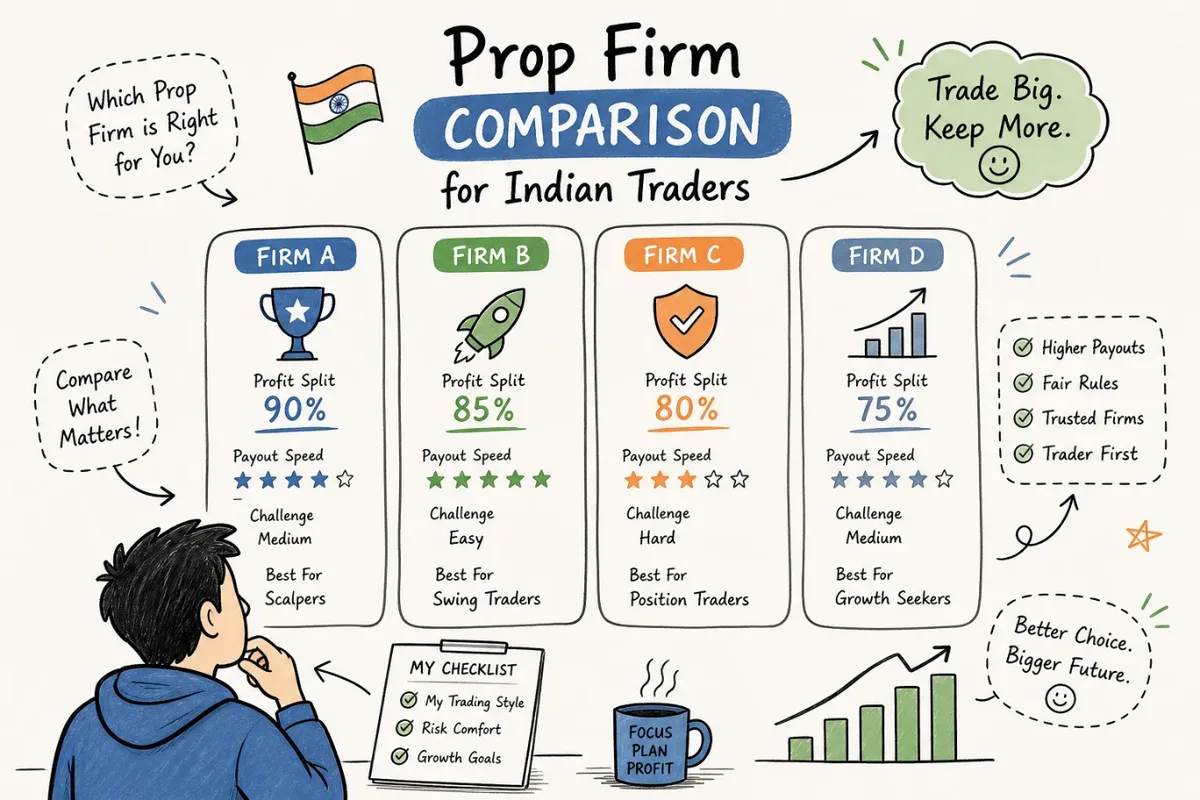
Prop Firm Comparison for Indian Traders: 2026 Picks
Thirty-eight prop firms now accept Indian traders. A working comparison of challenge costs in rupees, drawdown mechanics, profit splits, INR payout methods, and MT5 support — no sponsored rankings.

Prop Firm Evaluation Strategy: A Playbook to Get Funded
Roughly 42% of failed challenges trace back to maximum loss violations, not bad entries. A practical playbook for risk parameters, position sizing, a daily routine, and the behavioural traps that end most evaluations.

How to Protect Your Prop Firm Account During News Events
A Tier 1 news release can spike spreads 20–40x in milliseconds. Here's exactly what to do in the 30–60 minutes before NFP, CPI, or FOMC, during the blackout window, and before you re-enter after the print.

Tradeaikya vs Manual Rule Tracking: What Keeps You Compliant
Roughly 85–90% of prop firm challenge failures stem from rule violations, not a weak trading edge. Where spreadsheets and checklists break down, and how pre-execution compliance checking closes the gap.
How to Trade Multiple Prop Firm Accounts Without Violating Rules
The rules that trip up multi-account prop traders most often — daily drawdown, news windows, copy-trading restrictions — and how to build a setup that stays compliant across all your funded accounts.
MT5 Multi-Account Execution: Why Timing Gaps Cost Prop Traders Funded Accounts
Copy-trading tools introduce lag between accounts. In prop firm trading, that lag creates different fill prices, triggers consistency rules, and costs funded accounts. Here's what actually happens during multi-account execution.
What Is a Pre-Execution Firewall? GenieX Explained
Most trading tools review your decisions after the fact. A pre-execution firewall intercepts them before the order goes out. Here's what GenieX checks, what verdicts it returns, and why the timing matters.
Tradeaikya vs Manual Multi-Account Trading: A Prop Trader's Comparison
What actually changes when you replace manual tab-switching and copy-trading tools with a purpose-built multi-account terminal? A direct comparison across execution speed, compliance, and cognitive load.
How Prop Firms Detect Rule Violations — And How to Stay Compliant
Prop firms use automated systems to monitor drawdown, position limits, and news trading in real time. Here's how detection works and what traders can do before the violation happens.