The industry pass rate for prop firm challenges sits at 5 to 10 percent. That number gets cited often, usually to explain why trading is hard. But understanding prop firm challenge rules reveals the more accurate explanation: most traders who fail do not fail because they cannot trade. They fail because they broke a rule they either misunderstood or forgot to check. Often, that comes down to a specific calculation they assumed they understood.
At Tradeaikya, we have observed funded accounts breached not by losses on the chart, but by a trader who did not realise their daily drawdown window had already reset, or who held a trade three minutes into an NFP release. The chart looked fine. The rule said otherwise. The account was closed. These are not edge cases — they are among the most common breach patterns we encounter.
Every rule in a prop firm challenge exists to test one thing: can you manage capital within defined constraints? If you understand the rules precisely before you place your first trade, you already have an edge over the majority of participants. That is what this article gives you.
Prop Firm Challenge Rules: How Drawdown Calculations Actually Work
Most traders memorise the percentages. Five percent daily limit. Ten percent maximum drawdown. They write them down and move on. The problem is not the number. It is the calculation method beneath it, and that is where challenges are lost.
How daily loss limits are calculated
Take FTMO's two-step challenge as the anchor example. The daily loss limit is five percent of the initial account balance. On a $100,000 account, your equity cannot drop below $95,000 at any point during the trading day — not your balance, your equity. That figure includes closed trade P&L, open floating losses, swap charges, and commissions, all counted simultaneously. A single open trade moving against you can trigger the breach before you have placed a second order that day.
The reset happens at midnight CET. Not at the start of your trading session. Not when you open your platform. If you are trading from India and you open MT5 at 9 AM IST, the daily counter has been running for four and a half hours. Any overnight positions that moved against you between 4:30 AM and 9 AM IST have already consumed part of your daily allocation. By the time you place your first intentional trade, the real remaining buffer is smaller than your mental model of it.
Static drawdown vs trailing drawdown: why the difference matters
Static drawdown is fixed from the initial balance and never moves. On a $100,000 account with a 10 percent static drawdown, the floor is $90,000 from day one. Grow the account to $115,000 and the floor stays at $90,000. Every dollar of profit permanently expands your safety margin.
Trailing drawdown works differently. The floor moves upward as your equity peaks, but never back down. Grow the same account to $115,000 and the floor rises to $105,000. You now have only $10,000 of working room. If the market reverses and your balance drops to $104,000, you are breached — still in net profit relative to your starting balance, but the account is closed. This is the distinction that catches traders who plan their risk around the original floor rather than the current one. FTMO's single-step challenge uses end-of-day trailing drawdown; its two-step uses static. Knowing which model you are on changes how you manage a profitable run.
Profit Targets, Time Limits, and Phase Structure
The evaluation structure determines how long you have and what you need to achieve. Getting these numbers right before you begin is the plan itself, not merely preparation for one.
Phase 1 and Phase 2 targets across major firms
The industry-standard two-phase structure runs at 8 percent in Phase 1 and 5 percent in Phase 2. FTMO uses 10 percent and 5 percent. FundedNext's Stellar 2-Step uses 8 percent and 5 percent. Single-step models are growing, with targets ranging from 7 to 10 percent, and several firms have moved to unlimited time windows. Phase 1 time limits are typically 30 calendar days; Phase 2 runs 60. If you are attempting a 10 percent target in 30 days with a 5 percent daily loss limit and a 10 percent maximum drawdown, the arithmetic on required daily returns versus permitted daily losses leaves very little room for a bad session. Position sizing and trade frequency need to be decided before day one, not adjusted in week three.
The minimum trading days rule and why traders ignore it
FTMO requires a minimum of 10 trading days per phase. FundedNext's Stellar requires 5. The rule exists to prevent traders from gambling a challenge in one or two sessions. What many traders miss is a tightening that several firms have introduced: minimum profit or minimum trade activity per day is now required, not just a day count. Showing up and placing one micro-lot trade does not satisfy the requirement. A trader who completes a near-perfect challenge in 12 days, hitting the profit target cleanly, can still have the result voided if the activity requirement was not genuinely met. It is the rule that fails traders silently, after they think they have already won.
Prop Firm Challenge Rules, News Trading, Hedging, and Hard Bans
The rules in the previous sections involve thresholds. You can be close to the limit and still be compliant. The bans in this section have no threshold. You either crossed the line or you did not.
News trading restrictions and blackout windows
Most major firms prohibit opening new trades or holding existing positions within a defined window around high-impact events: NFP, CPI, FOMC. FTMO's documented window is two minutes before and two minutes after the release, applied to targeted instruments only. Non-targeted pairs during a US news event are typically unrestricted. Explicit blackout windows have been written into rulebooks at firms that previously left this language ambiguous, a trend visible in updated documentation from firms such as FTMO and The5%ers. For Indian traders, the highest-risk events — US payrolls and Fed decisions — fall between 6:30 PM and midnight IST, in the middle of active trading sessions. A trader running a mental checklist at that moment, under live market conditions with positions open, is the highest-risk scenario for this type of breach.
Hedging, automated systems, and position sizing limits
Three bans appear consistently across funded trader challenge rules. Hedging on the same instrument — holding simultaneous long and short positions, including across accounts at the same firm — is almost universally prohibited. Fully automated third-party EAs and external signal services are banned at most firms; self-developed tools are sometimes permitted, though off-the-shelf bots and copied signals are typically not. The third constraint is effective position sizing: most firms do not publish a hard lot cap, but they enforce one through the combination of daily loss limits and the maximum drawdown. A single trade or a correlated cluster of trades that risks more than roughly 1–2 percent of the account balance in a volatile session is a direct path to breach. Check your specific firm's rulebook for exact thresholds, as the figure is rarely stated explicitly — it is the consequence of the rules that are.
How Breaches Actually Happen in Real Trading
The rules make sense when you read them slowly at a desk. Applying them consistently at 6:45 PM IST with an open position and an NFP release in eight minutes is a different matter entirely.
The breach triggers traders rarely see coming
Scenario one: a trader ends a strong session up three percent on a $100,000 account. Feeling disciplined, they leave one trade open overnight. Swap charges accumulate. An early morning price gap, common in Asian session opens, pushes floating equity below the maximum drawdown threshold before the London open. No new trade was placed. No impulsive decision was made. The account breaches before the trader has opened their platform for the day.
Scenario two: a trader enters a session with multiple correlated positions across two instruments. Each position appears within limits when viewed individually. Viewed together against the trailing drawdown floor, which shifted upward after last week's profitable run, the combined exposure breaches the maximum drawdown threshold the moment volatility spikes. Neither position alone would have triggered a breach. The cluster does. Both scenarios are avoidable. Neither requires bad trading to occur.
Why speed and pressure amplify compliance risk
At the moment of execution, particularly before a news event or immediately after a losing trade, a trader is not consulting a rulebook. They are reacting. The sequence that leads to a blown challenge unfolds quickly: a loss, a snap decision to recover it, an oversized position, a second larger loss. It does not pause for a compliance check. This is precisely where a pre-execution validation layer closes the gap. A firewall that checks every order against current account equity, news windows, and position sizing rules before it reaches the broker removes the dependency on the trader remembering to check at the right moment. That is what Tradeaikya's GenieX does: it validates every order before it leaves the screen, provides a clear reason for every block, and operates the same way whether the market is calm or in free fall.
Pre-Trade Compliance: Prop Firm Challenge Rules Checklist
Running a structured check before every trade is not overthinking. It is the behaviour that separates the traders who pass from those who do not. The checklist is simple. Applying it consistently is the actual skill.
Key prop firm challenge rules at a glance
Before each trade on a funded or challenge account, verify the following:
- Current account equity versus the daily loss floor for this specific session, accounting for the midnight CET reset (4:30 AM IST)
- Current account equity versus the maximum drawdown floor, using the current trailing floor if applicable, not the original one
- Whether any high-impact news event falls within the next ten minutes, and whether your intended position spans a restricted instrument
- Whether the intended lot size keeps total risk within your firm's stated limits, typically 1–2 percent of the account balance, including any correlated open positions (check your specific rulebook for exact thresholds)
- Whether positions on any connected accounts create a hedging exposure under the firm's cross-account rules
- Whether any challenge fee, withdrawal condition, or phase-specific rule applies to the current session (some firms restrict trading during payout processing periods)
This is not a one-time setup task. It is a pre-trade ritual that must run every session, on every account, without exception.
Why manual tracking fails as accounts scale
On a single account, this checklist is manageable. On three or four simultaneous funded accounts, each with a different drawdown floor, different phase rules, and potentially different firm rulebooks, the cognitive load becomes unreliable. The floor on Account B has shifted because you had a profitable week. Account C is at a different firm with a stricter news window. Account A is in Phase 2 with different minimum activity requirements.
Tradeaikya's GenieX pre-execution firewall was built for exactly this situation. It validates every order across all connected MT5 accounts against prop firm rules and live market conditions via NewsHub, incorporating the trader's behavioural patterns via Trader DNA, all before the order reaches the broker. Every check is logged. Every block comes with a clear explanation. The result is an auditable record of every decision, which matters if you ever need to contest a breach notification with a firm.
The edge is in understanding the rules before you trade
Prop firm challenge rules are not designed to trip you up. They mirror the risk discipline that managing real capital demands. Every firm that imposes a trailing drawdown is asking: can you protect a gain as well as you protect against a loss? Every minimum trading day requirement is asking: can you sustain a consistent process, or are you looking to gamble a result? The rules are a test of systems, not just skill.
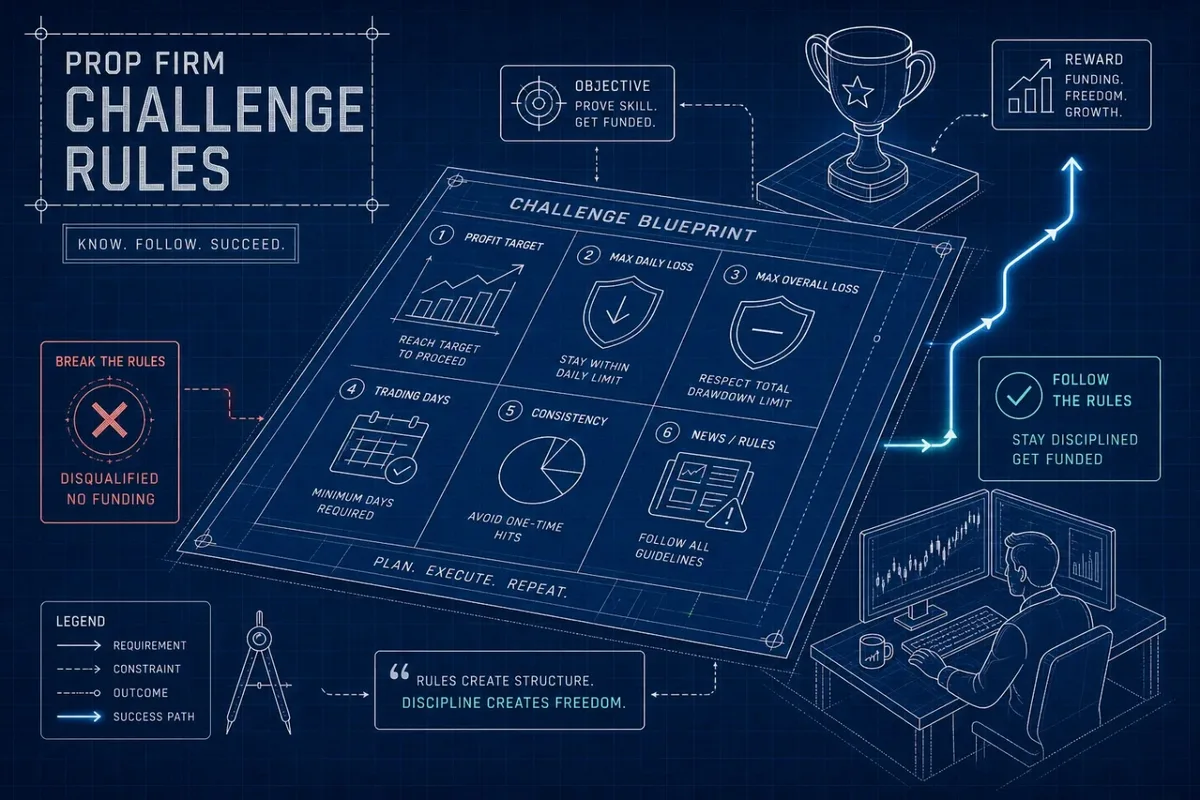
The rules that matter most are these: daily loss limits that include floating positions and swap, not just closed trades; maximum drawdown that can trail upward as you profit; minimum trading days that often require genuine activity rather than a day count; news blackout windows that have been explicitly written into many rulebooks in recent years; position sizing constraints that function as risk management requirements in everything but name; and withdrawal conditions that vary by firm and phase.
Before your next trade on a funded account, run the compliance check. Know your exact drawdown floor for today, not the one from last week. Know the next high-impact event on the economic calendar and whether your open positions span a restricted instrument. Know your current floating risk across every connected account. If doing that manually across multiple accounts feels unreliable, that is precisely the problem Tradeaikya's GenieX was built to solve.